How SEO Experts Use AI in Practice: 13 Professionals Share What’s Working

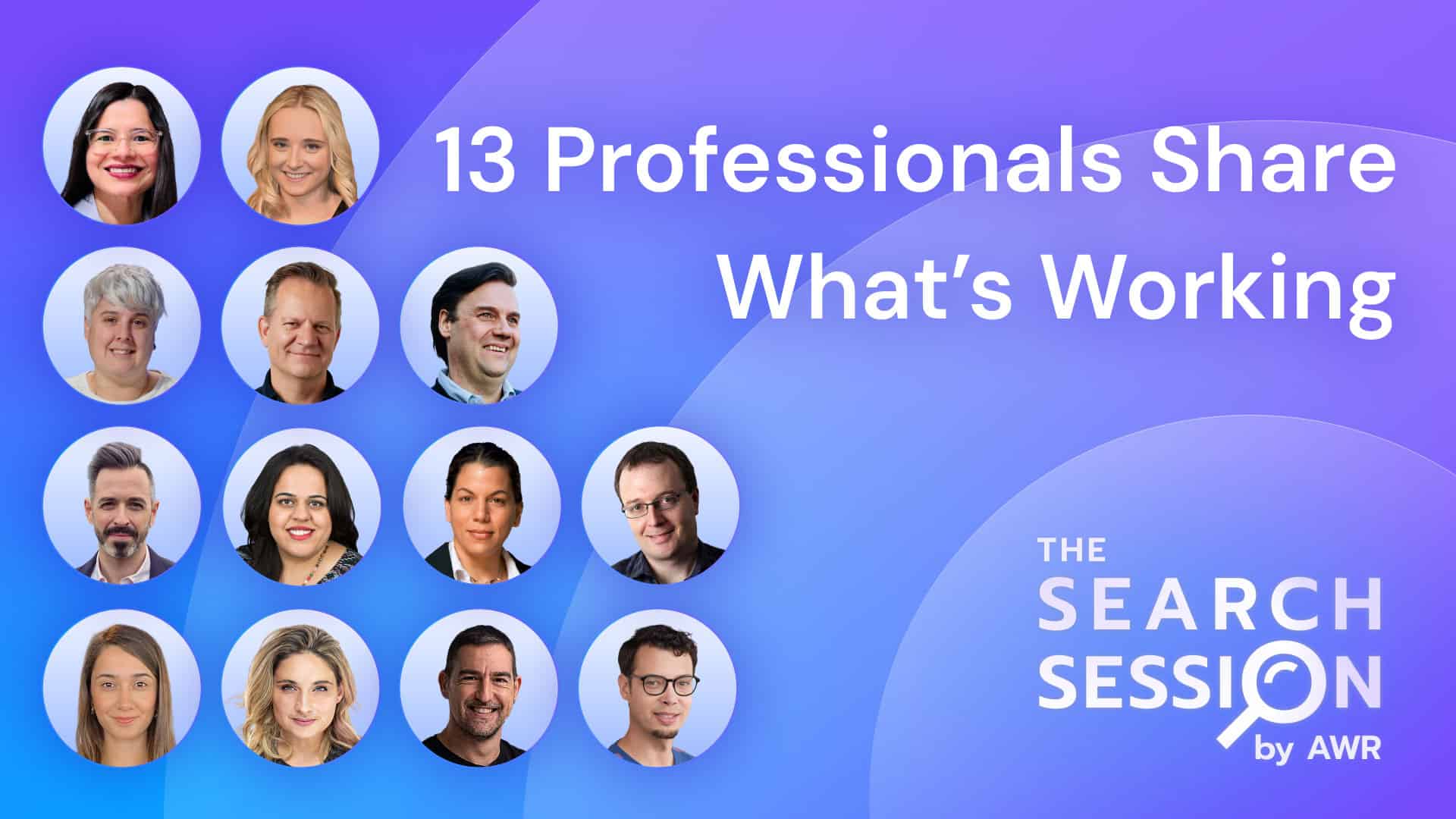
AI has changed how SEO professionals work, and not always in the ways most predicted. It’s not replacing expertise – it’s being folded into daily workflows in ways that are practical, specific, and often surprising.
This article gathers insights from 13 experienced SEO professionals on how they use AI in their work. Not in theory, but in practice: what they’ve tested, refined, and found genuinely useful.
The insights come from conversations recorded on The Search Session, a podcast by Advanced Web Ranking, where guests consistently returned to AI as one of the most significant changes in how SEO work gets done today.
What follows are the strongest takeaways from those conversations, the approaches worth knowing, the thinking behind them, and the ideas you can apply directly to your own SEO work.
Aleyda Solís - Award-Winning International SEO Consultant
Aleyda Solis uses AI to accelerate analysis while keeping her core SEO workflow anchored in the specialized tools she already trusts.

A lot of my AI use is really about identifying patterns across data I’ve already analyzed, or data I’ve obtained, validated, and filtered using the tools I’m already working with…
That’s why I believe that downloadable versions of LLMs with an MCP setting, would be ideal for this.
Aleyda Solís
Award-Winning International SEO Consultant
Insights and takeaways from Aleyda:
- Treat AI as a speed multiplier, not a tool replacement.
- Validate data with your SEO stack first, then use AI to reveal patterns.
- Avoid duplicating workflows that established tools handle better.
- Prioritize privacy-friendly, locally integrated LLM features.
Podcast episode with Aleyda Solis: YouTube, Blog, Spotify, Apple Podcasts
Sophie Brannon - Digital Agency Co-Founder & Director
At StudioHawk, Sophie Brannon uses AI to speed up content briefs and client-sentiment monitoring.
Having some form of automation and AI to tell us things like “Are they happy?” “Are they not?”, and being able to jump on these things sooner rather than later, yes, it’s really something we’re starting to leverage at every point.
Sophie Brannon
Digital Agency Co-Founder & Director
In her personal life, Sophie uses AI to automate anything repetitive and free up time.
I’m doing SEO, running the business, training the team, I’m across everything, across two different regions at different points, plus all the traveling and speaking I’m doing. So anything I can automate, I do.
Sophie Brannon
Digital Agency Co-Founder & Director
Insights and takeaways from Sophie:
- Use AI to standardize and accelerate content briefs.
- Track client sentiment with AI and act early.
- Automate anything repetitive to protect strategic focus.
- Experiment continuously to stay ahead of the curve.
Podcast episode with Sophie Brannon: YouTube, Blog, Spotify, Apple Podcasts

MJ Cachón - Spanish SEO Consultant and Strategist
In our conversation, MJ Cachón emphasized the need to separate AI automations from the parts of SEO that require real human judgment.
It’s really about being conscious of what each model can actually help you with. But always making a separation between people and… ‘monkey tasks.’ This kind of task can be done by a machine. But for the rest, I need a person who has intuition, who has empathy, who can speak with people, and understand the nuances that are silently present in communication.
MJ Cachón
Spanish SEO Consultant and Strategist
Her three go-to AI use cases:
- Gemini: “If you give Gemini a list of keywords and a list of categories, it’s very accurate in classifying them.”
- Claude: “I always try to use it for programming, for JavaScript, Python, whatever. It’s very accurate with coding.”
- Lovable: “Useful to build a landing page or a tiny website… In maybe half an hour, the website is done.”
Insights and takeaways from MJ:
- Automate only the repetitive “monkey tasks”, never human judgment.
- Don’t use AI for tasks that simple scripts or tools handle better.
- Use AI models based on strengths (Gemini = classification, Claude = coding).
- Keep humans responsible for interpretation, communication, and strategy.
Podcast episode with MJ Cachón: YouTube, Blog, Spotify, Apple Podcasts
Michael Bonfils - Global Digital Marketing Leader
On the podcast, Michael showcased an AI localization tool whose output was nearly indistinguishable from human work. For years, this work required multiple translators and reviewers, which made the process slow and expensive.
Now, we have AI tools that can get localization fine-tuned to that 95% level…
And because of this, the cost… has dropped by anywhere from 50% to 80%.
Michael Bonfils
Global Digital Marketing Leader
He also uses Character.ai and ChatGPT to run virtual focus groups, testing ideas across markets before launching campaigns.
I created this scenario: a Spanish skier going to Switzerland…
Each of these characters used their own tone, behaviors, and perspectives, based on psychographic data we’d collected. When they got together to discuss the backpack, they generated content they all agreed on and genuinely liked…
This is how we’re developing content strategies now. Instead of putting keyword data at the center of our customer journeys, we’re putting real behavior and emotion.
Michael Bonfils
Global Digital Marketing Leader
Insights and takeaways from Michael
- Scale localization with AI at dramatically lower cost.
- Keep accuracy high by comparing human and AI outputs side by side.
- Build strategies around behavior and emotion instead of keyword lists.
- Treat AI as a fast, low-cost testing ground for ideas before rollout.
Podcast episode with Michael Bonfils: YouTube, Blog, Spotify, Apple Podcasts
Arnout Hellemans - SEO, PPC, and Analytics Consultant
Arnout Hellemans uses AI as a sparring partner to pressure-test his thinking—describing problems he’s stuck on and letting the model surface angles he might miss. Most suggestions he filters out, but occasionally one stops him cold.
I describe the problems I run into… two points are completely stupid, three are already checked, and one makes me go, ‘Oh wow, I didn’t think about that.
Arnout Hellemans
SEO, PPC, and Analytics Consultant
He also uses AI for content production at scale:
I used Veo 3 to generate probably 40–50 variants I could use on TikTok, YouTube Shorts, Instagram, and Meta ads
Arnout Hellemans
SEO, PPC, and Analytics Consultant
On the technical side, he built automated systems that check whether a page is worth indexing and draft core on-page elements instantly.
It saves an incredible amount of time… the system flags what matters and drafts the core on-page elements instantly.
Arnout Hellemans
SEO, PPC, and Analytics Consultant
Insights and takeaways from Arnout:
- Use AI as a thinking partner to uncover angles you may overlook.
- Turn product photos into videos with AI.
- Automate repetitive on-page tasks with brand-guided LLM prompts and APIs.
- Train focused models for structured, high-volume tasks like image recognition.
Podcast episode with Arnout Hellemans: YouTube, Blog, Spotify, Apple Podcasts

Insights and takeaways from Arnout:
- Use AI as a thinking partner to uncover angles you may overlook.
- Turn product photos into videos with AI.
- Automate repetitive on-page tasks with brand-guided LLM prompts and APIs.
- Train focused models for structured, high-volume tasks like image recognition.
Podcast episode with Arnout Hellemans: YouTube, Blog, Spotify, Apple Podcasts
Rand Fishkin - Leading Voice in Marketing and Search
Rand Fishkin uses AI in SparkToro to expand audience datasets and improve query coverage. When users search for roles, it surfaces equivalent titles via ChatGPT to match more relevant profiles and generate content ideas directly inside the platform.
We saw customers exporting SparkToro data into ChatGPT, so we decided to bake those prompts directly into the product and deliver the output inside SparkToro.
Rand Fishkin
Leading Voice in Marketing and Search
Rand also notes that most AI use today isn’t replacing search.
When we did our analysis of ChatGPT prompts, which was classifying maybe around a million prompts… it was 70% plus generative tasks… and maybe a little more than 40% of all AI prompts were something to do with programming… Things you would never do, and could not do with a search engine.
Rand Fishkin
Leading Voice in Marketing and Search
Insights and takeaways from Rand:
- Query expansion with LLMs retrieves better audience matches.
- Built-in prompts help users turn research into action faster.
- Most real AI usage focuses on creation and problem-solving, not classic search tasks.
- Integrating AI where users already work reduces friction and increases adoption.
Podcast episode with Rand Fishkin: YouTube, Blog, Spotify, Apple Podcasts
Purna Virji - Award-Winning Strategist and Author
Purna Virji uses AI to speed up analysis, refine content, and support strategic thinking. At LinkedIn, she works with AI-powered tools that make content and campaign creation faster.
One of our tools is called Accelerate. It’s an AI-powered campaign builder. You just input a URL, and it handles a lot of the heavy lifting for you…
You can also use it to generate images to pair with your posts which is helpful, since posts with visuals tend to perform better than plain text.
Purna Virji
Award-Winning Strategist and Author
For her, AI should enhance authenticity, not obscure it:
Use AI, but… feed it your tone, your brand voice, your actual examples. Make sure it still feels like you so that people are connecting with a real identity, not an impersonal mask.
Purna Virji
Award-Winning Strategist and Author
Insights and takeaways from Purna:
- Use AI to enhance your voice, not replace it.
- Let it polish content, create visuals, and add captions to improve performance.
- Leverage tools like LinkedIn’s Accelerate to build campaigns quickly from a URL.
- Trust AI to synthesize reports, identify patterns, and support strategic thinking.
Podcast episode with Purna Virji: YouTube, Blog, Spotify, Apple Podcasts
Judith Lewis - Digital Marketing Pioneer
Judith Lewis uses AI to streamline work with large datasets, starting with clean data and clear context, making sure the model understands what it’s analyzing before producing output.
So what I do is format the data properly, and then I send it to Gemini. Lately, I have even just used Gemini directly inside Google Sheets.
Judith Lewis
Digital Marketing Pioneer
She relies on it to spot patterns and classify large volumes of scraped data, gaining speed without giving up control. Every output is reviewed and corrected using her own expertise.
It did the bulk of the work much faster… but you absolutely cannot just send it off to the client without reviewing it first.
Judith Lewis
Digital Marketing Pioneer
Insights and takeaways from Judith:
- AI helps analyze large datasets quickly.
- Clear data preparation and precise context improve output quality.
- Working with AI inside tools like Google Sheets streamlines analysis.
- AI classifications accelerate work but always require human correction.
Podcast episode with Judith Lewis: YouTube, Blog, Spotify, Apple Podcasts
Ian Lurie - Digital Marketing Pioneer
Ian Lurie uses AI daily as a collaborator: a tool to critique his ideas, follow up on assumptions, rewrite sections of text, or consolidate data. But he avoids using AI to automate SEO tasks.
If you can’t make good decisions without AI, you’re not going to make good decisions with it.
Judith Lewis
Digital Marketing Pioneer
He also leans on AI to challenge his thinking when he already understands the subject well.
AI isn’t terrible at taking a look at your assumptions and potentially challenging them, if you ask it to.
Judith Lewis
Digital Marketing Pioneer
Insights and takeaways from Ian:
- Treat AI as a space to explore angles, and refine early ideas.
- Lean on it for technical polish, like rewriting or turning complex notes into clearer structure.
- Automating SEO analysis with AI leads to average, generic output, human judgment is still essential.
- Use it to stress-test your assumptions, but only when you already understand the domain well enough to judge its arguments.
- Avoid handing over full SEO analysis; without your expertise, the output becomes unreliable.
Podcast episode with Ian Lurie: YouTube, Blog, Spotify, Apple Podcasts

Yagmur Simsek - Independent SEO and Content Strategist
Yagmur Simsek relies on AI to handle production at scale while human editors ensure accuracy.
That’s why we decided to use a few different tools on the AI side of the project but we also work with real human editors.
Yagmur Simsek
Independent SEO and Content Strategist
Her daily workflow combines multiple AI and SEO tools for research, writing, and structuring content.
We use ContentGo.AI for content writing… AlsoAsked.com to understand user behavior… Keyword Insights for grouping… and tools like Advanced Web Ranking and Semrush.
Yagmur Simsek
Independent SEO and Content Strategist
Insights and takeaways from Yagmur:
- Start with a clear strategy, then add AI to scale content production.
- Create a shared prompt library so the whole team briefs AI consistently.
- Use specialized tools together: ContentGo.AI, AlsoAsked, Keyword Insights, AWR, Semrush.
- Keep a one-pager brand guide to align both AI outputs and human work.
Podcast episode with Yagmur Simsek: YouTube, Blog, Spotify, Apple Podcasts
Talia Wolf - CRO and Digital Optimization
Talia Wolf uses AI to deepen analysis and uncover meaningful insights, but only when the input is rich and specific.
One of the things we really focus on at GetUplift is the idea of garbage in, garbage out. So if you’re going to feed something like ChatGPT rubbish data, that’s exactly what you’re going to get back… If we really want to get meaningful information… we have to make sure we’re feeding it the most important and relevant information.
Talia Wolf
CRO and Digital Optimization
Ricardo Tayar approaches AI by narrowing his focus to just a few areas where it can meaningfully enhance his work.
I decided a while ago to just focus on two or three areas, because if you try to understand everything about AI, it’s just impossible for one person. So right now, I’m focusing on GPTs, how to train them… on data analysis… and then design as well.
Ricardo Tayar
CRO and Digital Optimization
Insights and takeaways from Talia & Ricardo:
- Provide AI with detailed, high-quality input to get reliable analysis back.
- Include motivations, concerns, and intent, not just demographics, when feeding AI research data.
- Choose a few AI skill areas to master rather than trying to learn everything at once.
- Prioritize the AI capabilities that directly support your daily work and deepen your expertise.
Podcast episode with Talia Wolf & Ricardo Tayar: YouTube, Blog, Spotify, Apple Podcasts
Gus Pelogia - Senior SEO Product Manager
Gus Pelogia uses AI not just for writing or analysis, but to build quick prototypes that test whether an idea is feasible before involving engineers. He often runs small tests with his own API key, iterating until the model behaves well enough.
It’s not doing exactly what I need… Then you tweak the prompt and test again… is it still doing 80% of what I need? If yes, cool, I’ll manually review the rest.
Gus Pelogia
Senior SEO Product Manager
Once the prototype works, he hands it off for proper development:
I actually do that a lot, build an MVP myself, prove that it’s possible, and then hand it off to a team that can take it further.
Gus Pelogia
Senior SEO Product Manager
Insights and takeaways from Gus:
- Prototype SEO ideas with AI before investing engineering time.
- Iterate until the model achieves “good enough” accuracy, then refine manually.
- Use your own API keys to experiment freely without process bottlenecks.
- Rely on Colab or similar platforms to skip installation barriers and run quick tests.
- Treat AI as a feasibility-check tool: validate first, scale later.
Podcast episode with Gus Pelogia: YouTube, Blog, Spotify, Apple Podcasts

Final thoughts
Across these conversations, AI emerges as a natural extension of SEO work: a way to move faster, pressure-test ideas, and explore options that once required far more time and effort.
As search expands beyond a single platform and tools continue to evolve. What ultimately defines strong outcomes is not the technology itself, but the ability to apply it with judgment: knowing when to rely on the machine, when to question it, and when human insight must lead.
In the end, the advantage comes from understanding people, creating with the right intent, and using expertise in ways that are clear, useful, and easy to recognize both by people and AI models.
Thanks for reading!
View more case studies
Building a Community-Led Content Strategy for SEO Businesses


What Jolene taught me about SEO: Patterns, Logic and Results

How GPT Apps Could Impact Your GEO Strategy