If you’ve been paying close attention to how ChatGPT has evolved over the past six months, you’ll have noticed something that deserves more in GEO conversations: the rise of GPT Apps. Not Custom GPTs, not search grounding, actual applications living inside ChatGPT that can take actions on your behalf, pull live data, and interact with your accounts. This is different, and it matters for how we think about brand visibility in AI environments.However, it’s all dependent on one pointapp invocation!
What Are GPT Apps?
At DevDay in October 2025, OpenAI introduced the Apps SDK,a framework built on top of the Model Context Protocol (MCP) that lets developers build interactive experiences directly inside ChatGPT conversations. By December 2025, the App Directory went live at chatgpt.com/appsand the first wave of approved apps began rolling out: Expedia, Spotify, Canva, Instacart, Dropbox.
These aren’t GPTs with a system prompt. They’re proper applications with visual interfaces, backend connectionsand the ability to execute tasks. OpenAI’s own framing is instructive: apps “bring new context into conversations and let users take action.” That word ‘action’is what separates them from anything that came before in the ChatGPT ecosystem.
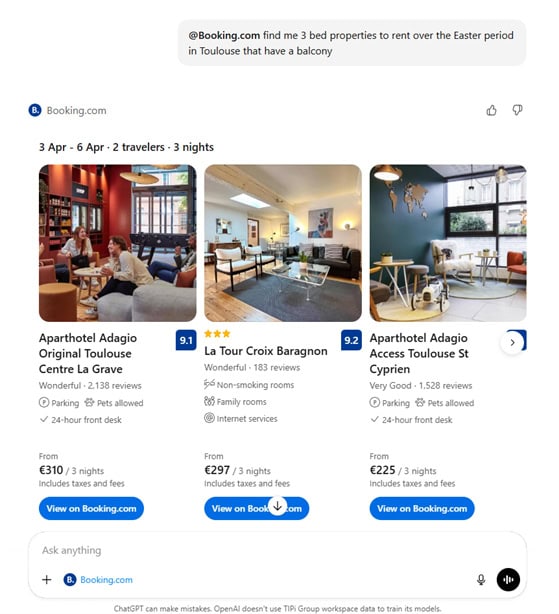
An app inside ChatGPT can display a map with live hotel listings,create a playlist in your Spotify accountand even build you a slide deck in Canva without you leaving the conversation. The key distinction is that apps do things; they don’t just answer questions about things.
What’s striking is how fast major brands have moved on this. At ROAST, we published an article about what we’re calling the “App Store” moment for AI:MoneySuperMarket launched on February 20th, Skyscanner followed on February 25th and Rightmove has since announced its own ChatGPT app. This isn’t a handful of experimenters, it’s a coordinated first wave across Travel, Finance, Property, Retail, and Health. The land grab has started.
To track which UK and global brands have already built ChatGPT apps and which categories are moving fastest,ROAST have built the ROAST ChatGPT App Tracker, a free tool that maps the growing ecosystem. This tool is worth bookmarking if this space is on your radar.
The @ Mechanic: Brand Mention as Activation
Right now, GPT Apps are user-initiated. You trigger them in one of two ways: by selecting them from the tool’s menu (+), or by typing @BrandName in your prompt. If you’ve installed and connected the Expedia app, for example, you can type “@Expedia find me hotels in Athens for late May” and the app activates, pulling live inventory directly into your conversation.
This process is known as invocation. You have to “invocate” the app to use it.
This is a fundamentally different relationship between brand mention and AI output than what GEO practitioners have been optimising for. In search grounding or general LLM citation, the goal is organic inclusion, having your brand surface in a synthesised answer because you’re a trusted, well-represented source in the model’s training data and retrieval pool. With GPT Apps, the brand mention is the activation trigger. You either have the app, or you don’t. You either know to type @ or you don’t.
That changes the GEO question from “how do we get cited?” to “how do we get installed and recalled?”
For brands this creates an interesting upstream challenge. Ofcom data shows ChatGPT received 1.8 billion UK visits in the first eight months of 2025,up from 368 million in the same period of 2024. People are already there in volume. But if users don’t know your app exists, or don’t think to @ you, you’re invisible in a way that’s different from traditional search invisibility. There’s no page two to stumble onto. There’s no featured snippet. You’re simply not in the room.
But that’s the huge problem, how do you get users to think about you brand before they prompt? But that might not be required. Here is the kicker around invocation.
But the Future Points Beyond the @ Mention
Here’s where it gets strategically interesting. OpenAI has already signalled that explicit invocation is just phase one. In their December 2025 developer announcement, they stated clearly thatthey’re “experimenting with ways to surface relevant, helpful apps directly within conversations — using signals like conversational context, app usage patterns, and user preferences.”
In other words: proactive app surfacing. ChatGPT, reading the context of your conversation, decides to suggest or activate an app without you explicitly asking for it. Early signs of this direction are already visible in ChatGPT Pulse, which proactively surfaces insights from connected apps likeGmail, Google Calendarbased on your chat history and stated preferences.
The implication for brands is significant. If ChatGPT begins contextually triggering apps based on conversational intent, then having an app in the directory stops being a passive distribution play and becomes a genuine presence mechanism. You don’t need the user to know your brand name and type @. You need ChatGPT to recognise that your app is the right tool for this moment.

That’s a GEO problem, not just a product problem and it’s one that traditional citation-based GEO tactics won’t directly solve.
Why Apps Beat Search Grounding — and By Some Distance
GEO practitioners have spent considerable energy on understanding ChatGPT’s search grounding feature:the ability of the model to pull real-time web results into a response and cite sources. It’s a valid channel but GPT Apps have structural advantages that are worth spelling out clearly.
Live, proprietary data. Search grounding is limited to what’s publicly crawlable and indexable by Google and Bing. A GPT App connected to your backend can surface live pricing, real-time inventory, personalised availability, dynamic rates:data that a web crawl simply can’t access. If you’re Booking.com and a user asks, “what’s available in Athens next weekend?”, search grounding returns a static page. Your app returns actual rooms, live.
Filtering and specificity. Apps can expose complex filter logic through natural language. A user can say “show me hotels in Athens under £150 a night with a gym and free cancellation” — and a well-built app can execute that query against live inventory in real time. Search grounding can describe what filtering options exist on a website. It can’t execute them for you.
Actions on your account. This is the decisive advantage. A GPT App can complete transactions, create bookings, update your profile, save preferences — all within the conversation. Consider the hotel booking example in full: a user tells ChatGPT they’re heading to Athens for a conference in May. Without an app, ChatGPT might suggest some hotels, link out to Booking.com or Expedia, and the user clicks away, re-enters their details, and completes the booking elsewhere. With a Booking.com or Expedia app properly connected and authenticated (Logging in with your existing account with Booking.com etc), the entire flow — search, filter, review, book — can complete inside ChatGPT. No tab-switching. No re-authentication. No drop-off. The conversion happens at the moment of intent, inside the AI, on the user’s terms.
That’s a fundamentally different value proposition than any SEO or GEO tactic has ever been able to offer. The friction goes to near zero.
Which Brands Lend Themselves to the Apps Future?
Not every brand has an obvious GPT App play. But the categories that lend themselves to this model share some common characteristics: transactional intent, live inventory or availability, and meaningful account-level personalisation. The early App Directory data backs this out — the ROAST ChatGPT App Tracker shows Travel, Finance, Retail, and Health are the categories moving fastest, which isn’t a coincidence. These are all sectors where doing something is the point, not just knowing something.
Travel and hospitality is the obvious front-runner. Skyscanner and Expedia are already there. The ability to search, filter, and book a flight or room within a conversation is a near-perfect use case. User intent is clear, the action is well-defined, and the alternative — clicking out, re-authenticating, navigating a website — is meaningfully worse.
Financial services is moving quicker than expected. MoneySuperMarket and CompareTheMarket launching, in particular, have a very natural conversational interface. “Find me the cheapest car insurance for a 35-year-old in London driving a VW Golf” is a better GPT App prompt than it is a Google search.
Property is worth watching closely. Rightmove’s entry is significant precisely because the property search journey is already high-friction and high-stakes. A conversational layer that lets users describe their lifestyle and get matched to areas and listings — rather than wrestling with postcode filters — is a genuinely better product experience. As we highlighted in the ROAST piece, a user might ask: “I’ve been offered a job in Manchester; suggest areas for a young family with excellent schools and a four-bed house for under £450k.” Traditional search engines struggle with that level of nuance. A well-built property app thrives on it.
Retail and grocery Instacart is among the early approved apps. If a user is discussing a dinner party menu and can say “@Instacart add these to my cart for delivery tomorrow”, that’s a useful compression of intent into action.
Productivity and creative tools — Canva and Dropbox launching early signals that this space understands the model well. The conversational interface maps naturally to the iterative, task-based way creatives and marketers already work.
The Bigger Picture: Reducing OpenAI's Reliance on Search Engines
There’s a platform-level angle worth acknowledging for anyone thinking about the long-term GEO landscape. OpenAI’s search grounding capability means ongoing dependence on Bing (and increasingly Google) as the retrieval layer beneath ChatGPT’s answers. That’s a structural vulnerability for a company trying to become a primary information interface for hundreds of millions of people.
GPT Apps offer an alternative architecture. If brands are connecting their own live data directly into ChatGPT via the Apps SDK and MCP, then ChatGPT doesn’t need to index the web to answer questions about hotel availability in Athens or mortgage rates from a specific lender. The data comes directly from the source, in real time, through authenticated connections.
That’s a meaningful step toward OpenAI building a closed-loop information ecosystem — one where they’re not intermediating a search index, but hosting an action layer. Every app that connects live, proprietary data to ChatGPT is one more reason for OpenAI not to need Google or Bing to answer that category of query. The more apps in the directory, the more categories where search grounding becomes redundant. But will all website owners have the time and skills to make an app – which is why there may always be a need for a “Search Index” something OpenAI are said to be building.
For brands, understanding this dynamic matters. Being an early app partner isn’t just a distribution play in a new channel — it’s a positioning play inside a platform that’s actively building toward search independence. The brands that connect their data now will have meaningful structural advantages as that transition accelerates.
What This Means for GEO Strategy Right Now
GPT Apps won’t replace citation-based GEO overnight. The @ mention mechanic still requires user awareness and intent, the App Directory is nascent, and proactive contextual surfacing is experimental. But the directional signal is clear enough that it warrants getting ahead of it.
A few practical things to be thinking about:
Does your brand have a natural GPT App use case? The test is simple: is there something your product or service does that would be meaningfully better inside a conversation than on a website? Transactional brands with live data and account-level actions should be evaluating the Apps SDK now. The early wave of brands in the tracker already proves this isn’t theoretical.
How does your GEO strategy accommodate a world where brand recall drives AI visibility? If users need to know to type @YourBrand, then brand awareness and affinity feed the AI channel in ways they’ve never directly fed search. That’s a new brief for brand teams, not just SEO teams.
What does your app-layer data strategy look like? Search grounding surfaces what you publish. Apps surface what you connect. Those are different content and data infrastructure questions — and the latter requires conversations with product and engineering that most GEO strategies haven’t started yet.
The App Directory has been live for less than six months. The brands moving now are buying themselves a genuine head start — both in terms of user adoption and in terms of platform relationship with OpenAI. If the trajectory of Pulse and proactive surfacing experiments continues, the brands already embedded in that ecosystem will be the ones that get surfaced first when ChatGPT starts deciding which app to reach for on your behalf.
That’s a GEO problem worth solving early.
Thanks for reading!

View more case studies
Building a Community-Led Content Strategy for SEO Businesses


What Jolene taught me about SEO: Patterns, Logic and Results

How SEO Experts Use AI in Practice: 13 Professionals Share What’s Working