
Building a Community-Led Content Strategy for SEO Businesses

Content strategies used to be built primarily around the question: will this rank? That’s not the only question that matters anymore.
Being cited and mentioned is becoming just as valuable, if not more, in our AI-forward landscape. A community-led content strategy gets you talked about in those places you may not be able to reach with your current content strategy alone.
Here’s the advantage SEO businesses have that most industries don’t: your audience are already content creators. They’re writing, publishing, speaking and actively looking for more opportunities to do all three.
You’re not trying to recruit reluctant contributors – you’re meeting people on the path they’re already on. You’re opening more doors at a quicker pace along their journey.
All industries can benefit from a community-led content strategy, we just have a huge head start. Let’s get into it!
You don’t need your own community
Building a community from scratch is expensive, slow, and a full time job in itself.
The faster version is to find communities where your audience already lives and show up there – as a person, not a brand, with genuine helpfulness and consistency.
Your people are already gathering in Slack groups, LinkedIn threads, industry events, and niche forums. The opportunity is there, you just have to go for it.
What is community-led content?
Most content is created for an audience. Community-led content is created with one.
There’s two ways this typically happens and the distinction matters because they require different approaches.
- Prompted content: you ask
- Unprompted content: you earn it
The sections below break these down in detail with examples from the SEO and marketing industries.
1. Prompted content: you ask
You invite your audience to create content with you, published on your owned assets.
Guest posts, collaborative webinars, featured interviews, expert roundups – anything where you extend the ask and publish the results on your website, YouTube channel, newsletter, or your other owned assets.
Two things make this work:
- Ask clearly – what exactly do they need to do, what the process will be, and what the output will look like.
- Make the value obvious – what do they get? A byline, wider audience, their input used to make a change they care about, and ideally – payment.
Here’s a few examples of what this looks like in practice.
Snippets and crowd-sourced pieces
Angela Ash wrote a brilliant article – How to Turn Your Community Into a Collaborative Content Goldmine. The best part is she used the exact method she described to write it. She crowd-sourced voices from her communities.
The result is a high quality piece with more perspectives and 6 featured folks sharing the article out to their networks as well.

I loved this line:
“When you’ve selected someone to feature in your article, they transform from lending their insights to being an investor.
They’ve put their name, their thoughts, and a bit of their reputation on the line.
So, you’d better believe they’re going to want to share it.”
- Angela Ash, Content Manager & Digital PR Specialist at Flow Agency
An investor shares.
The same dynamic can play out at events. This approach from Jojo Furnival in creating SEO in 2026: 17 Expert Tips & Predictions is great.
Jojo recorded folks at brightonSEO giving their best tips for 2026 – like this one from the wonderful Tina Reis. Then used those on both YouTube and aggregated into the article.
The people featured became amplifiers the moment Jojo hit publish.
Updating older content
We’ve seen a few WTSPartners in our Women in Tech SEO community update outdated content with a community twist.
Sara Vordermeier put a call out in our Slack’s #wts-opportunities channel looking for folks to feature in various posts they were updating on their blog.

We see what Angela Ash called “being an investor,” in action as folks featured, like Dayna Lucio, start to share out their posts on socials and elsewhere:

That’s Angela’s investor effect in action. The ask itself builds trust and relationships.
Guests on podcasts & videos
Sourcing guests for your podcasts and videos from community is another way to live into a community-led content strategy.
Jo Cameron does this with Moz’s Whiteboard Friday Series. She often offers an additional opportunity for speakers at WTSFest to be amplified while in town for the conference.

The brilliant Victory Umurhurhu was recently featured after her 2026 WTSFest debut!

2. Unprompted content: you’ve earned it
This is where community-led content compounds. Someone mentions your brand, your tool, or your name without being asked. They mention you on a forum, in a Slack thread, in a LinkedIn post, on their own website – those valuable mentions that then show up in AI and traditional search answers.
You didn’t prompt it. You earned it.
Earning it requires three things, applied over time:
- Be consistent – show up in the same places, regularly.
- Be helpful – answer questions, share resources, connect people.
- Be yourself – not your brand – YOU!.
Do this long enough in a community and you’ll see how visibility is a byproduct of trust.
Here’s what that can look like in practice.
Showing up in the “room”
One of the best ways to earn trust is to participate in the community as a community member. Answer questions, give advice, help!
Navah Hopkins, Product Liaison for Microsoft Ads, gives us a brilliant example of this. She shows up in our WTS Slack community consistently – with over 853 Slack messages to date.
Navah shows up when folks have questions about Microsoft, but she’s not seeding the brand. She’s not dropping discount codes or pushing members to use Microsoft Ads. And in many cases, like the one in the image below about Apple ads (nothing to do with Microsoft), she’s answering and amplifying other brilliant people to help.

That restraint on not going brand first is the key. She’s there for the community, not for the brand. And that’s exactly why the brand benefits.
We see a similar story with Dana DiTomaso, showing up in our Slack community with over 1,361 messages to date.
Dana is an analytics expert and a long-time WTS member.
The best way to build credibility in a community is to help consistently without expecting anything back. Dana does this – sharing resources, not just her own work, but anything she knows will help someone else.
One of my favourite examples is in the image below where she shared Ruth Burr Reedy’s Whiteboard Friday – nothing to do with Dana’s company, Kick Point. Not content created by Dana. In theory, nothing to gain from it. Just pure helpfulness.

People remember the people that help them. People trust the people that help them again and again.
And because visibility is a byproduct of trust, we see these folks share Dana’s name when others are looking for support:

Training people to become something
The highest-trust community content comes from helping people achieve an identity they want – helping community members become.
Become a writer, a speaker, a leader – become something they want to be and could use support getting there.
Training programs and certifications are a great way to do that.
Maria Kazakova and Guifré Ballester of another WTSPartner, SE Ranking, recently ran a WTSCohort – a small group training focused on building automation tools & workflows in a safe, judgement-free, community space.
We were aiming for 20 sign-ups and got 46. The Slack channel was super active and we saw folks sharing about the cohort from day 1:

Maria, Guifré, and the SE Ranking team helped members become API-fluent SEOs.
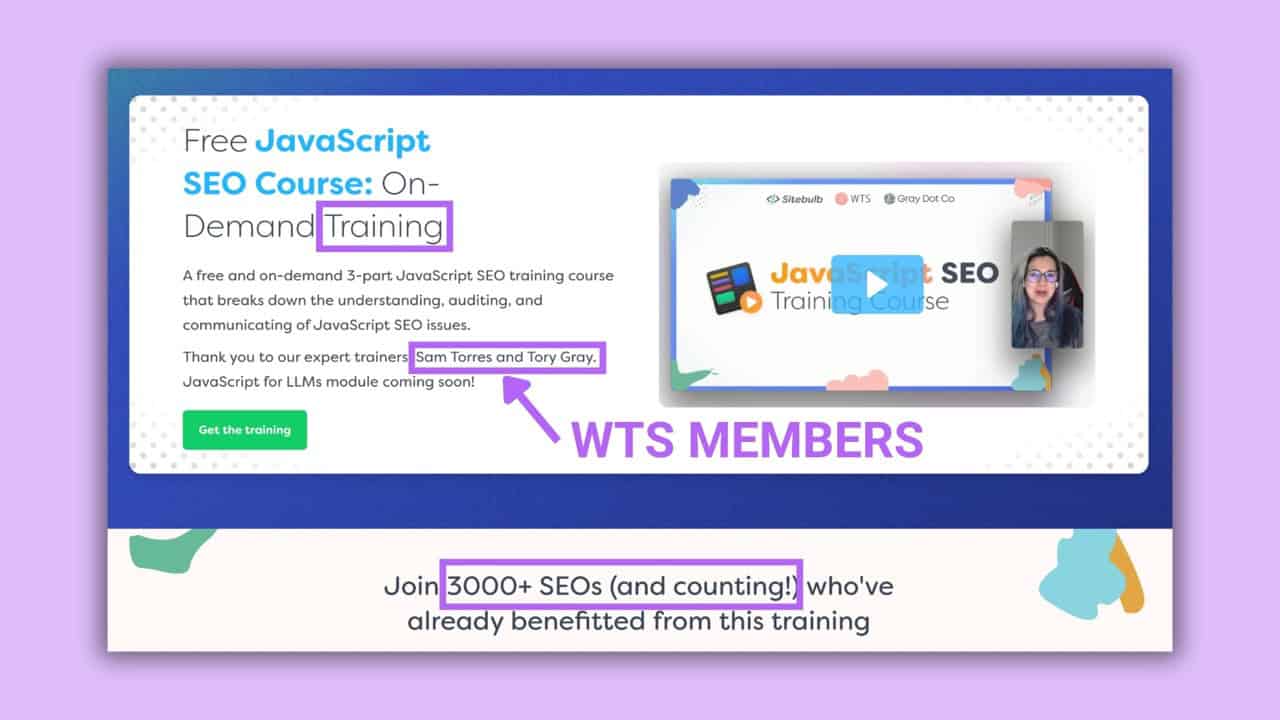
Another example from Jojo Furnival of Sitebulb: collaborating with WTS to create an epic educational resource – their free on-demand JavaScript SEO training course. Jojo started with a survey to find pain points of our community (actually listening to their audience’s needs) with the promise of a helpful resource.
They supercharged that resource by amplifying the expertise of two brilliant WTSers as the trainers – Sam Torres and Tory Gray.
Over 3,000 SEOs have taken that training. Many off the back of the trust-led visibility of folks sharing their certifications on socials after taking the course.
The best part – a community-led content strategy, when the brand is motivated by earning trust through being consistently helpful, can earn ROI. Last we heard, Sitebulb gained £50k in new recurring annual revenue from this initiative.
All because Jojo, Sam, Tory, and the Sitebulb team helped members become Javascript SEO-fluent professionals.
The shift
Many brands enter communities with the instinct to produce expertise for the community. To be seen as the authority.
Community-led content strategies require the opposite instinct.
The shift: from producing expertise for the community to producing opportunities for the community’s expertise to surface, grow, and be amplified.
Instead of positioning your brand as the authority, you position it as a platform through which authority moves. Other’s voices are amplified, their skills are grown, their networks widen.
This is a quieter, more subtle role. It’s also more durable.
Algorithm updates don’t stop someone from recommending you in a Slack thread or on Reddit. AI disruption doesn’t erase the fact that someone who wrote an article for you shares it with every new prospect they have.
The trust network you build in communities is structurally different from search rankings. It lives in people, not indexes.
And the best part is we see those search platforms prioritizing people in their results. You’re creating the signal they constantly look for to surface answers.
How to design for a community-led content strategy
Ask yourself three questions about how your brand is showing up in community right now – whether that’s digital communities, events, socials, or some other form of folks gathering to support each other.
- Who in your audience is trying to become something?
A more technical SEO, a conference speaker, an API-fluent marketer.
Is there an intersection between that desired identity and the person who buys or uses what you offer? - What could you create with them that helps them get there?
Research they contribute to. A training that gives them a skill they’re proud of. A byline, a quote, a platform.
Something that makes them a stakeholder and investor in what you’ve built together. - What proof can you give them to carry into the rooms you can’t enter?
A certification, credit, data points that makes their argument stronger.
Something they’ll proudly reference throughout their network.
A community-led content strategy isn’t a distribution play, it’s a trust play.
The citations, the mentions, and the resulting AI and traditional search visibility – those are your byproducts.
The actual, direct product is a person who got something real and valuable from your brand, and who carries you forward with them.
That’s what compounds. And it’s what no algorithm update touches.
Thanks for reading!
View more case studies

What Jolene taught me about SEO: Patterns, Logic and Results

How SEO Experts Use AI in Practice: 13 Professionals Share What’s Working

How GPT Apps Could Impact Your GEO Strategy